A Nurse's Confession About the Leaks No One Explains
I'm a pelvic-care nurse. I taught Kegels for 24 years. Then I wet myself in the Costco line at 58.
For two decades I told frightened women the same thing every doctor says. Then it happened to me, I did everything "right" for two years, and I found out we'd all been aiming at the wrong layer.


Me, at the kitchen table where I finally sat down and read the research I should have read twenty years ago.
I'm going to tell you something I'm not proud of, because I think a lot of you need to hear it from a woman who wore the badge.
I've been a nurse for twenty-four years, most of it in women's pelvic health. I have said the same sentence to more frightened women than I could ever count: "It's your pelvic floor, dear. Stay on your Kegels and it'll come back." I believed it completely. I taught it in classes. I wrote it on discharge sheets. I said it with the calm, certain voice they teach you to use, the one that makes a scared woman believe you.
So when it started happening to me, at fifty-six, I did exactly what I'd told all of them. I mapped the bathroom in every store before I shopped. I kept a folded pad in the bottom of my purse and hid it from my husband like a teenager. I got up at three in the morning, then again at four thirty, and told myself the same thing I'd heard a thousand women tell me: it's just my age. And I did my Kegels. Faithfully. Morning and night. For two years.
And I still leaked.
The morning it broke me
Let me tell you what those two years were actually made of, because I think you already know, and I think you have been carrying it alone the way I did.
It was the arithmetic of a woman who is always, quietly, doing math. One coffee at breakfast, not two, because two meant a problem by the time I hit the highway. The aisle seat, always, at church and at the theater and on the plane, so I could get out without climbing over anyone. The dark trousers, never the pale linen I loved, because dark hides things. The trampoline birthday party I skipped. The sneeze I learned to brace for, legs crossed, one hand on the counter, like bracing against a small wave. I stopped picking up my own grandson at the door because lifting him was a gamble I had started to lose. And every single night, that walk down the cold hallway at three, and again at four thirty, listening to my own body like it was a stranger in the house.
Then came the morning it broke me. I was standing in the checkout line at Costco. My daughter said something funny, I laughed before I could catch it, and, well. Fifty-eight years old, a pelvic-health nurse with two years of perfect Kegels behind me, and I had to leave a full cart in the aisle and walk out to my car. I sat in the parking lot and cried. Part of it was the embarrassment. But most of it, honestly, was anger. Because if I couldn't fix this doing everything by the book, what on earth had I been telling all those women for twenty years?
The nurse in me finally got angry
Here is the thought that would not leave me alone in that parking lot. If the standard advice actually worked, two years of doing it perfectly should have moved something. I know how muscle training works. I have watched women rebuild strength after childbirth, after surgery, after all of it. Two years of daily effort is not "you didn't try hard enough." That excuse is what we hand women when our own explanation falls apart.
So I stopped being the ashamed patient and became the stubborn nurse again. I went home, cleared the table, and actually read the research instead of repeating the advice out of habit.

I stopped feeling ashamed and started asking the question I should have asked years earlier: what if the advice itself was aimed at the wrong place?
What no one taught me in nursing school
Here is the part that stopped me cold, and I have a nursing license.
The pelvic floor is a hammock of muscle. It's real, it matters, and yes, you can train it. But the thing that actually snaps the bladder shut in the half-second when you laugh, sneeze, or lift a grandchild is not that muscle. It's a small ring of collagen at the neck of the bladder. Think of it as a seal, or a drawstring. Estrogen keeps that ring plump and springy. After menopause, when estrogen drops, the collagen in that seal thins and slackens.
The researchers have a name for it. They call it a fade. Pelvic Seal Fade. And once I read it, everything clicked into place at once.

The seal is a ring of collagen at the neck of the bladder (shown in gold). Estrogen keeps it firm. After menopause it fades, and no amount of squeezing a different muscle ever reaches it.
You cannot Kegel a collagen seal back to life. It is a completely different tissue, on a completely different layer, and squeezing the muscle underneath it does nothing to the seal itself. That one fact explained my two wasted years. It explained every patient who came back to me a year later, no better, quietly certain she'd failed at her exercises. She hadn't failed at anything. We had all been aiming one layer too low.
Why the whole field aims one layer too low
Once I saw it, I couldn't stop seeing it. Look at the entire ladder we put women on. First it's Kegels. Then weighted cones and phone apps. When those don't hold, out come the pads, aisle after aisle of them, sold to us for the rest of our lives. And at the very end of the ladder, a surgeon.
There is an enormous industry built on the muscle at one end and the leak at the other. There is almost nothing built for the seal in between, which is the actual thing that fades. Pads don't fix a fading seal. They catch what a fading seal lets through. That is why women wear them for twenty years and call it managing. I am not accusing anyone of a conspiracy. It's just habit, the same habit I taught out of for two decades. But habit had a whole generation of us squeezing a muscle to fix a seal.
I finally drew it out on the back of an envelope, the way I used to sketch things for my patients. When you put every option side by side and ask one plain question of each, does this actually reach the collagen seal at the bladder neck, the whole picture falls open. Here is that envelope, cleaned up.
| The approach | The layer it works on | Reaches the seal? |
|---|---|---|
| Kegels & weighted cones | The muscle hammock beneath the seal | No. Trains the layer under it. |
| Bladder-training apps & timed voiding | Your schedule and habits | No. Rearranges your day, not the tissue. |
| Pads & liners | The outside. Nothing internal. | No. Catches what the seal lets through. |
| Prescriptions & surgery | A medical route, with your doctor | Sometimes, and invasive. The last rung, not the first. |
| Feeding the seal (Veylor) | The collagen ring at the bladder neck | Yes. This is the layer nobody else works on. |
Four of the five rungs work on a layer that isn't the seal. That is not a failure of your effort. It is a gap in the map.
See the layer nobody works on →What I tried, and why the drugstore versions had already failed us
The research kept circling back to two plant compounds that support the collagen and tone of that bladder-neck tissue. But here is the catch that turned my stomach as a nurse. The benefit in the studies was tied to a specific, concentrated, standardized form at a real, measured dose. Not the watered-down versions I had personally sent women to buy at the drugstore for years.
I had told women to pick up pumpkin seed oil. The studies used a standardized, water-soluble seed extract, at a dose those soft little drugstore capsules never come close to. Wrong form. Wrong dose. No wonder it did nothing. It was never that the ingredient couldn't help the seal. It's that almost nothing on the shelf carried enough of the studied form to matter.
So I finally sat down and read the trial myself
This is the part where the nurse took over from the tired woman, and I want to walk you through it exactly the way I read it, because you deserve the actual evidence, not a slogan.
I pulled the study that mattered. It was published in the Journal of Functional Foods in May of 2014, and it was run by university researchers at Ewha Womans University. It was the kind of trial I was trained to respect: randomized, double-blind, and placebo-controlled. If you have never had those three words explained plainly, let me do it, nurse to friend. Randomized means the women were sorted by chance, not cherry-picked. Double-blind means neither the women nor the researchers knew who was getting the real blend and who was getting a dummy, so nobody could nudge the result. Placebo-controlled means they compared it against a fake pill, so you can see what the ingredient did on top of hope alone. That is the gold standard. That is the design you trust.
They took 120 women, aged 35 to 70, all dealing with the exact bladder trouble you and I know too well. Half got the standardized pumpkin-seed-and-soy-germ blend. Half got the placebo. The dose was one gram a day. They ran it for twelve weeks. And then they counted.
Read those numbers slowly, the way I did. The women on the blend reported about a third fewer trips at night. Think about what a third of your nighttime wakings would give back to you. The researchers also saw meaningful drops across the board: how often the women went, how sudden and hard the urge hit, how often they leaked, and their overall bladder-symptom scores all came down against the placebo. And this is the one that made me put the paper down and just sit for a minute. More than nine in ten of the women on the blend said it helped and wanted to keep taking it, compared with only about half of the women on the placebo. Nine in ten. These are not women who are easy to impress. These are women who have tried everything, like you, like me. And there were no adverse events reported in the trial. It was gentle.
There was a second study too, a smaller one, using pumpkin seed on its own. Forty-five adults, a larger daily amount of the seed, twelve weeks again, and their overactive-bladder symptom scores dropped significantly by the six-week mark and again at twelve. Two studies, pointing the same direction, at the same tissue, on a timeline measured in weeks, not years.
What a nurse hears in a study like that
Let me tell you what those two words, twelve weeks, mean to me, because they are the whole reason I trusted this over one more gadget.
Collagen is not a light switch. You do not firm a fading seal overnight, the same way you do not rebuild a tendon or heal a wound in a day. Tissue answers to time. So when a trial shows the numbers climbing at six weeks and still climbing at twelve, that is not a disappointment to me, that is exactly what real tissue repair is supposed to look like. It told me this was working with the body's own slow schedule, feeding the seal rather than whipping a muscle. A gadget promises a switch. Biology promises a season. I will take the season every time.
And I want to be plain about what this is and is not, because I am still a nurse and I will not talk to you the way an infomercial would. The blend in that trial is studied to help support normal bladder control and the connective tissue that keeps the bladder neck sealed. It is not a drug. It does not treat, cure, or prevent anything, and any honest person will tell you individual results vary. What it does is feed the exact layer that fades. That was the missing rung on my envelope, and here, finally, was a real study putting a real number on it.
I am not the only one who found her way here, either. In my own circle and among the women who come through the clinic, a growing number of us over fifty have quietly stopped squeezing the muscle and started feeding the seal. Nobody prints that in a pamphlet. It moves the way real word among women always moves, one relieved friend at a time.
Feed the seal the studied way →What actually changed for me
I went looking for the studied form and dose, and I'll be honest about why. I was a skeptic. I fully expected to prove to myself that it didn't work so I could stop chasing it and go back to my pads.
The first two weeks, nothing. I nearly quit. Then, somewhere around three weeks in, I slept through the night and woke up dry, for the first time in years. I lay there almost afraid to believe it. By the second month, the folded pad in the bottom of my purse had been sitting there so long, unused, that it had become a little relic of who I used to be. I cried again in that Costco parking lot a few weeks later, in the same spot. The good kind this time.
I want to be careful here, because I'm still a nurse. This isn't a switch you flip. It's a tissue you feed, slowly, so it can firm back up. It supports the seal. It is not a miracle and it is not a cure. What it needs from you is a fair, full run, not two skeptical weeks like I almost gave it.
The afternoon my daughter caught me
The moment I knew it had really changed, though, wasn't private. It came from someone else's mouth.
It was a Sunday, the whole family in the backyard, and my son-in-law told a story so ridiculous that I laughed. Not the careful laugh. Not the one with the crossed legs and the hand quietly finding the counter. The whole, loud, head-back laugh I used to have in my thirties, before I started rationing it. I didn't brace. I didn't scan for the bathroom. I just laughed.
And my daughter went quiet. She looked at me across the yard, and she said it out loud, in front of everyone: "Mom. You laughed like that and you didn't even flinch."
That was the moment I understood she had been watching all along. She had seen the aisle seats and the dark trousers and the way I'd stopped scooping up her son at the door. She had been carrying my worry with me, silently, the way daughters do, and she had just watched it lift. I had spent two years thinking I was hiding it so well. She had seen every bit of it, and now she got to see it go.
A week or so later I ran into a woman I'd nursed years back, right there in the pharmacy aisle where I used to send her for liners. She looked at me for a second too long and said, "You look ten years lighter. What are you doing?" So I told her. Of course I told her. That is how this actually travels between women, and it is why I am telling you now.
Here is exactly what I take, and what it costs
The version I found that actually uses the studied, standardized dose of pumpkin seed extract and soy germ is a supplement called Veylor. I don't tell you that as a saleswoman. I tell you as a nurse who did it the "right" way for two years and got nowhere, until I fed the seal instead of squeezing the muscle. It is made here in the United States, and it is built to the full one-gram blend the researchers used, not a sprinkle of it.
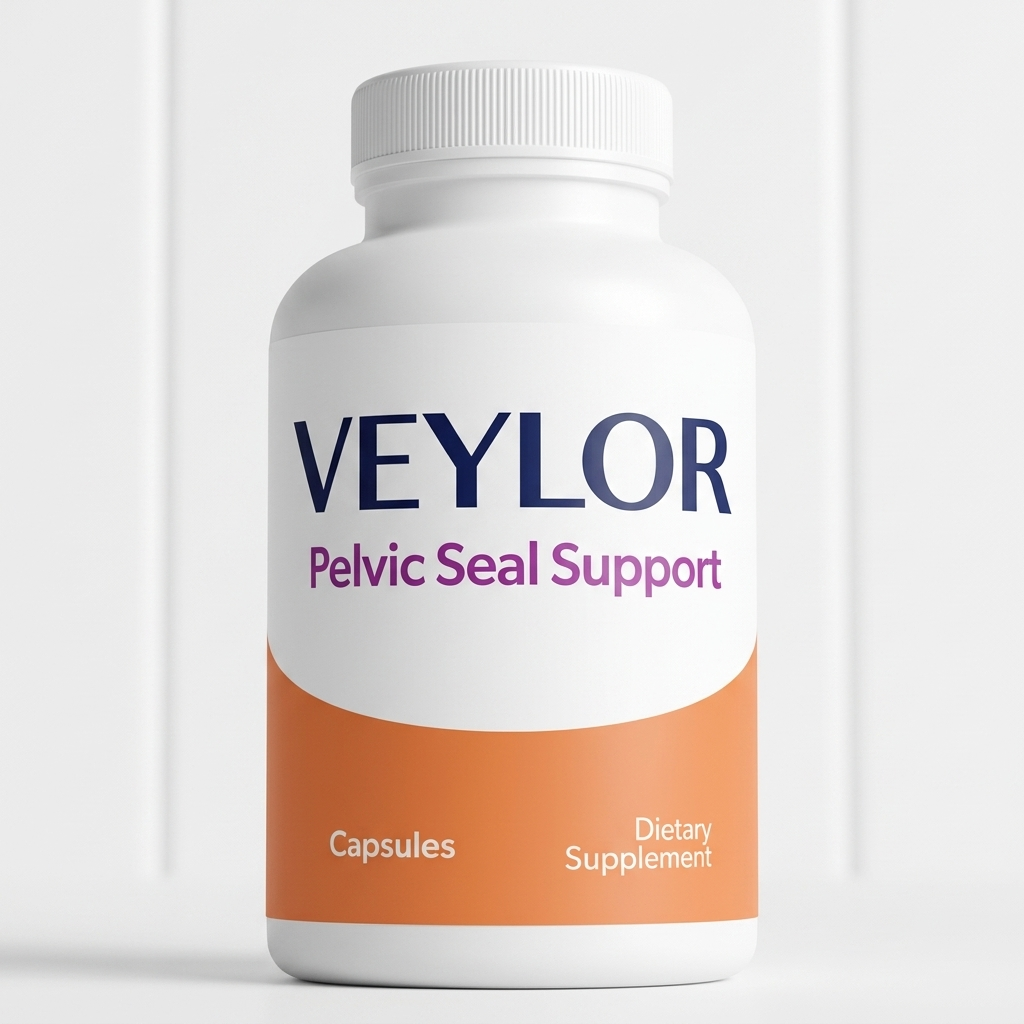
The form that finally matched the research
The standardized pumpkin-seed extract and soy germ, at the one-gram studied dose, made in the USA. Free, discreet shipping in a plain box with no wording on the outside. Every order is backed by a 90-day keep-the-bottle promise.
The three-month option works out to about $0.94 a day to feed the seal, less than the coffee you gave up guarding your morning. Every tier ships free, in a plain, discreet box.
Choose my supply →It comes with a 90-day promise. If it doesn't change your nights and your days, you keep the bottle and get your money back. That guarantee is the only reason I ever felt safe telling one of my own patients to try it.
Most women I talk to start with the six-month supply. Not because anyone pushes it on them, but because a fading seal firms back slowly, and they want to give it an honest, full run instead of judging it in a skeptical fortnight. That's exactly what I did, and it's exactly what the twelve-week research would tell you to do.
Why I can tell you to keep the bottle
I need to sit on this a moment, because as a nurse it is the part I care about most. I spent twenty-four years being careful about what I told frightened women to spend their money on. I did not start recommending this until I understood the guarantee, and the guarantee is genuinely unusual.
You have ninety days. That is not a two-week trial that ends before collagen could possibly answer. Ninety days is long enough to give the seal the same twelve-week run the women in the study got, and then some. And if at the end of it your nights and your days have not changed, you do not mail anything back and wait by the door. You keep the bottle, and you get your money back. Empty, full, half-used, it does not matter. The company is betting on the tissue doing its slow work, and they are putting their money where the science is.
Sit with what that actually means for you. The worst case is not that you are out the money. The worst case is that you tried, it wasn't for you, and you are refunded, still holding the bottle. All of the risk sits on their side of the table. None of it sits on yours. In twenty-four years I never once got to tell a patient that.
Try it with the seal on my side →Why there isn't an endless supply
I'll tell you the plain truth about why this isn't stacked to the ceiling like the pads are. Building Veylor to the full one-gram studied dose of the standardized, water-soluble extract is slow and it is expensive. It is not the pressed pumpkin oil you can barrel by the ton. The standardized extract comes in real batches, and a batch takes what it takes.
So the company makes far fewer bottles than a pad company moves in a single afternoon. When a run sells through, and among women over fifty it moves faster than anyone planned, the next batch is weeks away. I am not going to insult you with a ticking clock on a screen. I am telling you the honest reason the "back in stock" note keeps showing up: they refuse to water down the dose to make more, and I would not recommend it to you if they did. If it is in stock as you read this, that is the batch to take.
Two roads, and you're standing at the fork
I want to be as honest with you as I wish someone had been with me at fifty-six, before I burned two years.
Picture the first road, the one where nothing changes. It is not dramatic. That is the trap of it. It is just another year of the same quiet arithmetic. One coffee, not two. The aisle seat. The dark trousers. The folded pad riding in the bottom of the purse. Another year of the three a.m. hallway and the four thirty return. The grandchildren getting bigger and heavier while you get more careful about lifting them. And slowly, without ever deciding to, you shrink your own life down one skipped invitation at a time until the world you move in is small enough to feel safe. That road doesn't get better on its own. A fading seal does not un-fade because you waited. It is the one thing on that whole envelope that only goes one direction when it is left alone.
Now the other road. You feed the seal the studied dose, you give it the honest twelve-week run the research asked for, and you find out. Ninety days, the bottle is yours to keep either way, and every bit of the risk sits with the company, not with you. That is the entire fork. Not a leap of faith. A protected, refundable ninety days against the layer that no exercise, no pad, and no app was ever going to reach.
If you take one thing from a nurse who spent twenty-four years teaching the wrong layer, let it be this: the leak on a laugh, the three a.m. trips, the pad you hide, the map of every bathroom in town, none of that is a character flaw and none of it is a failure of effort. It's a seal that faded when your estrogen did, on a layer nobody ever taught us to look at. And for the first time, there is something that goes to that layer.
Take the protected road →One last thing, from one woman to another
I have thought a lot about why I finally wrote this down. Part of it is guilt, honestly. Two decades of discharge sheets with the wrong advice on them. Part of it is the woman I ran into at the pharmacy, and the fact that she is now sleeping through the night because I told her. But most of it is that I remember exactly what it felt like in that parking lot, and I would not wish that particular loneliness on anyone.
So here is my plain nurse's recommendation, the one I would give you across my own kitchen table. Give the seal the same twelve-week run the women in the study got. You are protected by the ninety-day promise the entire time, and the bottle is yours to keep no matter what. If it isn't for you, you will have lost nothing. If it is, you will get back a version of yourself you may have quietly said goodbye to. I did. I would very much like the same for you.
Feed the seal for about $0.94 a day
The standardized pumpkin-seed extract and soy germ, at the one-gram studied dose. Free, discreet shipping. 90 days to decide, and you keep the bottle either way.
Start my 90-day run →90-day keep-the-bottle guarantee. If your nights and days don't change, you're refunded and you keep the bottle.
So if you've done your Kegels like a good patient and still leak, please hear this from someone who has been on both sides of the exam table: it isn't you, and it isn't your effort. It's the layer no one taught us to look at.
Warmly, Ellen Hartley, RN
P.S. Remember what the fork really is, because the fear makes it look bigger than it is. On one side, another year exactly like the last one, and a seal that only fades further while you wait. On the other, a protected ninety days, free discreet shipping, and a bottle that stays yours even if you ask for every dollar back. All of the risk is theirs. If it's in stock as you're reading this, that is the batch I'd take, because the next one is weeks out. Feed the seal while this batch lasts →
What other women are saying

“For two years I was up three, sometimes four times before dawn, tired before the day even started. A few weeks on this and my nights got quieter. Most mornings now I wake up realizing I never got up at all.”

“I used to brace every time a joke landed, because a real laugh meant a little escape. I wore black slacks everywhere, just in case. Now I laugh at my grandkids without that flinch, and I've started reaching for color again.”

“Every jump and quick pivot used to end with that little leak, so I quit the game I loved. About six weeks in, the leaks when I move eased off enough that I'm playing pickleball three mornings a week.”

“I slept straight through last night. No getting up at three, no lying there waiting for sleep to come back. First time in longer than I can remember.”

“My granddaughter had me laughing so hard at dinner and I just laughed. No bracing, no reaching for a towel. That used to be the moment I dreaded.”

“The folded towel that lived on my car seat is in the wash for good. I quit mapping out every restroom before I leave the house.”
Advertorial. Sponsored content produced for Veylor. "Ellen Hartley, RN" is a composite narrator used to illustrate a common experience; her account reflects the brand's perspective and is not the medical advice or testimonial of a specific individual. The clinical figures described refer to published research on the pumpkin-seed-and-soy-germ ingredient blend, not to Veylor as a finished product. Individual results vary.
These statements have not been evaluated by the Food and Drug Administration. This product is not intended to diagnose, treat, cure, or prevent any disease. Individual results vary. Persistent, sudden, or severe urinary symptoms can have medical causes; please talk with your doctor before starting any new supplement.