Before You Let Them Cut
Women's Wellbeing Daily · Health
I Cancelled My Bladder Surgery Two Weeks Before the Date. Here's the One Sentence That Changed My Mind.

The night before I was supposed to confirm the surgery.
If a surgeon has you booked for a bladder sling, and some quiet, stubborn part of you keeps hunting for the exit, please read this before your date. I was you. The surgery was on my calendar. My finger hovered over the cancel button for three weeks. And what finally let me press it wasn't courage. It was a single sentence a nurse said to me, almost by accident.
I'm 59. The leaks started a few years after menopause, the way they do for so many of us, a little when I sneezed, then a little when I laughed, then a pad every single day so I was never caught out. I did everything I was told, in the right order, like a good patient.
I did pelvic floor therapy. Not once, three separate rounds, at two different clinics. It helped a little, and then it stopped helping. I was fitted for pessaries. I even had a Bulkamid injection, and for about a year it was wonderful, and then one week it simply quit on me and I was right back where I started. I tried the medication and lasted six weeks before the dry mouth and the fog got unbearable.
"I'd really rather not have surgery, so I'll exhaust all other options first."
That was my line, over and over, to every doctor. But I was running out of options, and the last door left was the operating room. And honestly? Part of me had already given up on solving it. Part of me was ready, in the words of a woman I'd read online, "to deal with the devil I knew, a pad every day, forever, for the rest of my life."
So I booked the sling. $7,000 out of pocket. A catheter for four days. No lifting for weeks. A fifteen percent complication rate. And when I asked my surgeon, plainly, whether it would actually last, she told me the truth I'll always respect her for: "Don't expect a hundred percent. For most women it's about eighty percent better. It's not a miracle cure."
Eighty percent. Maybe. For $7,000 and a surgery I might have to redo in five years. That's what I was about to sign for.
Then a nurse said the word no one else had said
At my pre-op, I asked the nurse to remind me how the Bulkamid injection I'd had a couple of years back even worked. She said it so casually: "Oh, that's a little gel they inject into the wall of the urethra, to improve the seal at your bladder neck."
The seal. I had been leaking for years, sat through three doctors and a dozen appointments, and not one of them had ever named the thing that was actually failing. There was a seal. And every treatment I'd been handed, I suddenly realized, was just a different way of getting at it.
I went home and, for the first time, I understood my own body.
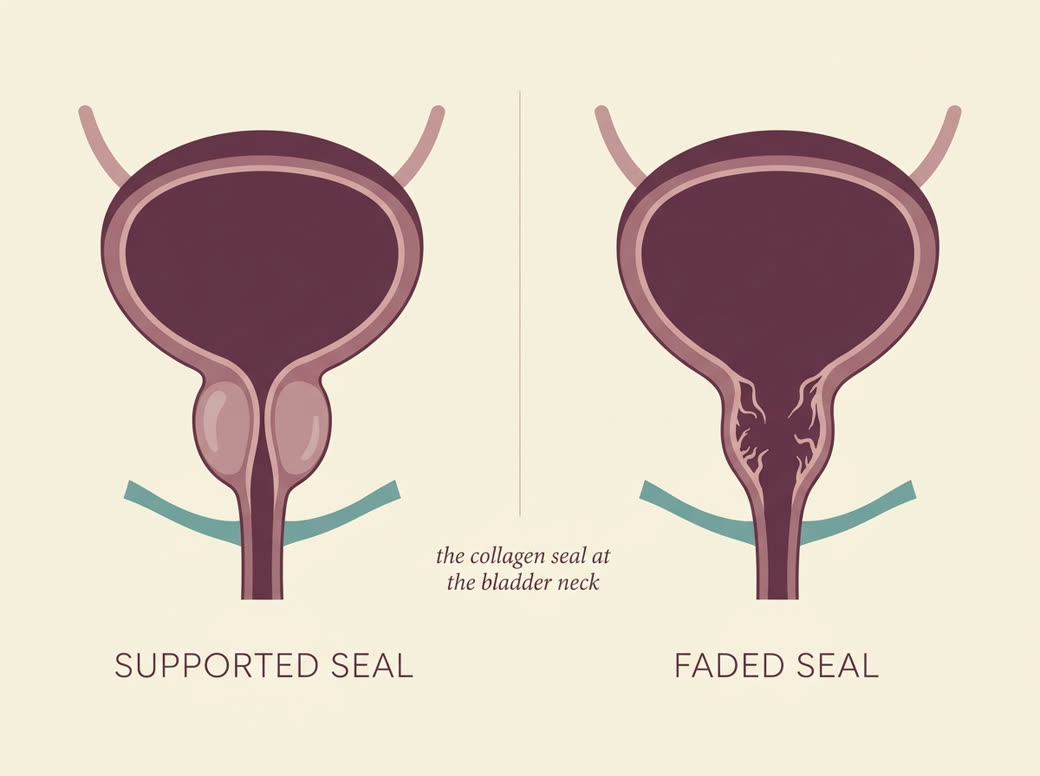
A supported seal closes. A faded one no longer does. This is the part nobody was treating.
Once I saw it, everything I'd tried made a sad kind of sense. The pelvic floor therapy strengthened a muscle, but the seal isn't a muscle you squeeze, it's collagen you have to feed, so no amount of Kegels ever reached it. The pessary propped up the geometry from outside. The Bulkamid bulked the urethral wall mechanically, which is why it worked, and why it wore off. The medication just muted the signals. The pads and the underwear caught what the seal let slip, a full layer downstream. And the sling? The sling is a surgeon physically hammocking the whole thing, because the tissue itself has thinned.
Every single one of them was aiming at the seal. The surgeons included. The only difference was the price and the knife.
Which left me with one question I couldn't put down: if even the surgery is just a way to reach the seal, is there a way to feed that seal, the tissue itself, before I let anyone cut?
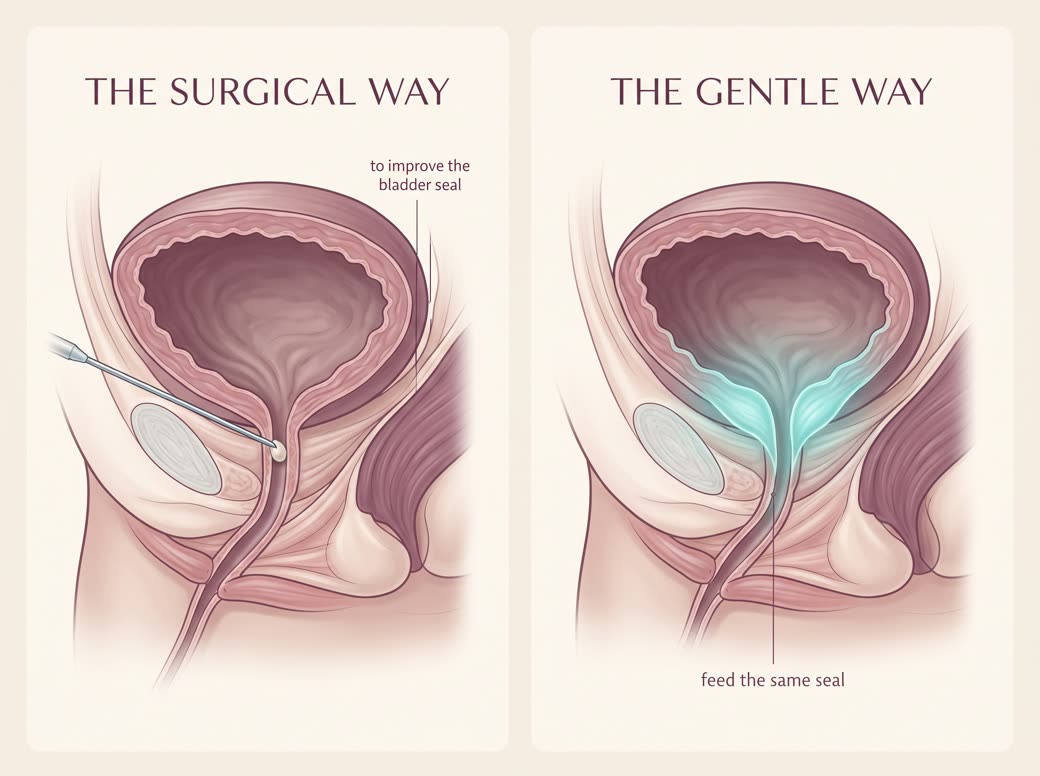
Same target. One reaches it with a needle. One feeds it from within.
The thing no one had put on my list
It turns out the tissue of that seal can be fed. There is a specific, studied combination of pumpkin seed extract and soy germ that works on exactly the collagen the estrogen drop stopped supporting, not by catching leaks, not by squeezing a muscle, but by nourishing the seal at the bladder neck itself.
It's the blend inside Veylor Pelvic Seal Support. And it's the first thing in this entire ordeal that was aimed at the cause instead of the consequence.
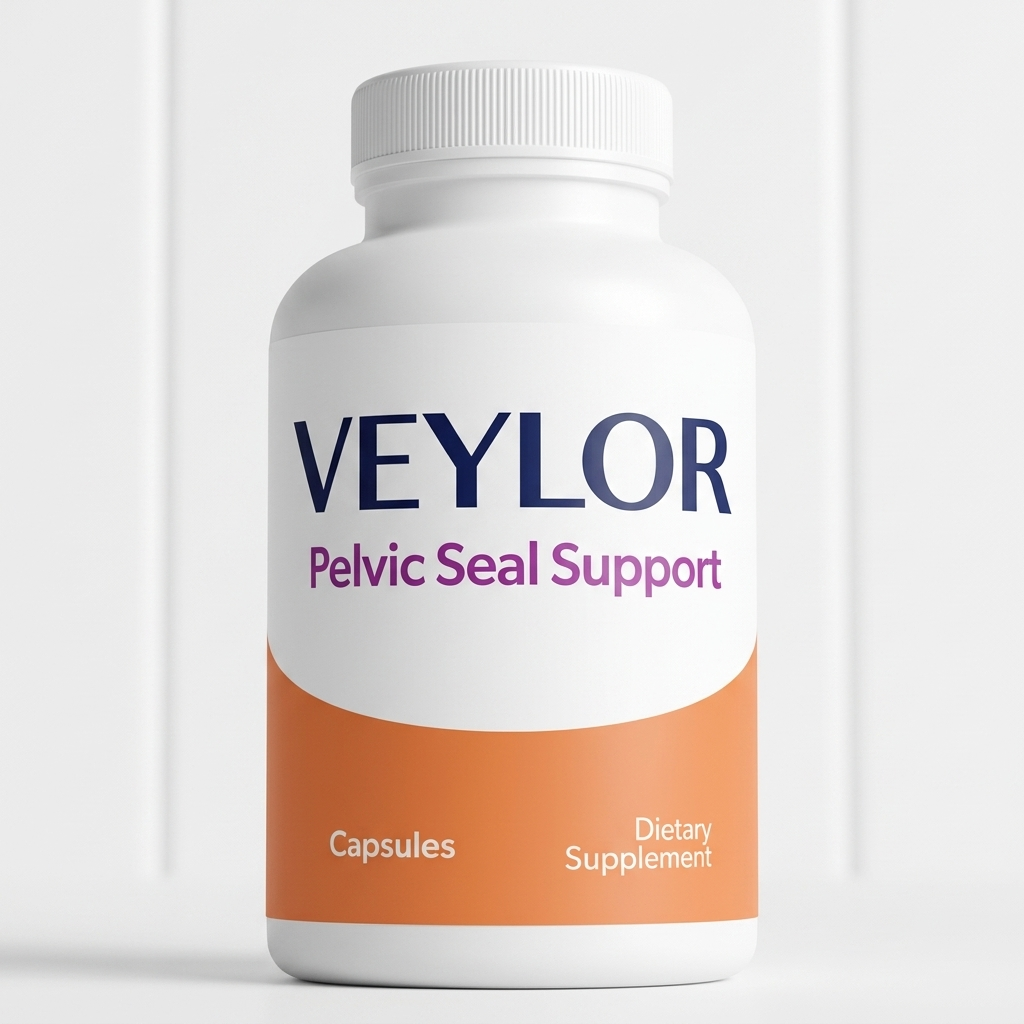
Veylor Pelvic Seal Support · pumpkin seed extract + soy germ, at the studied dose.
I wanted to know it was real before I let myself hope, so I looked for the actual study, not a testimonial. There is one. In a 12-week clinical trial of 120 women, this pumpkin-seed-and-soy-germ blend produced about a third fewer nighttime bathroom trips, and more than 9 in 10 women chose to keep taking it, versus about half on the placebo, with no adverse events reported. It is a supplement, not a scalpel, and it doesn't pretend to be one. But it was the only option anyone had ever handed me that fed the seal instead of working around it.
The three doubts I had to get past
"If PT and injections didn't work, why would this?" Because they weren't working the same thing. PT trained a muscle. The injection bulked a wall, temporarily. This feeds the collagen seal that losing estrogen quietly starved, the one layer none of them nourished. Different target, different lever.
"It'll take weeks." It will. Compare that to a four-day catheter and a six-week recovery with lifting restrictions. Weeks of waiting is the cheapest thing on this whole list.
"What if it does nothing?" Then you send it back. It comes with a 90-day, keep-the-bottle guarantee, so the only thing being wrong costs you is the wait. That is a far smaller gamble than the one already booked in your name. As always, keep your own doctor in the loop, especially before you cancel anything.
Women who tried it before the knife

Diane R.
★★★★★ Verified Buyer"I had the sling scheduled. I asked for three more months to try this first. I cancelled the surgery. I'm not saying it's magic, I'm saying I don't need the operation anymore, and I can't quite believe I almost had it."

Sharon M.
★★★★★ Verified Buyer"Two rounds of PT, a pessary I hated, and a Bulkamid that wore off. This is the only thing that kept working. I sleep through the night now. Nobody ever told me there was a seal, let alone that you could feed it."

Judith K.
★★★★★ Verified Buyer"I'm 66 and I was terrified of the surgery. Gave this eight weeks. I laughed at my grandson's birthday last Sunday, a real belly laugh, and stayed dry. I cried in the car after."

Feed the seal before you let anyone cut
The surgery is $7,000, "about 80% better," a catheter, and a possible redo in five years. Feeding the seal is a bottle and 90 days to find out, with nothing lost if it doesn't work for you.
90-day keep-the-bottle guarantee · Free discreet shipping · Cancel anytime
I still have the surgery paperwork in a drawer. I keep it there to remind myself how close I came to signing for a procedure that only ever aimed at the one thing I could feed myself, at home, for the price of a nice dinner, before I let anyone put me under.
If you're where I was, finger over the cancel button, do the small, reversible thing first. Feed the seal. The knife will wait.
These statements have not been evaluated by the Food and Drug Administration. This product is not intended to diagnose, treat, cure, or prevent any disease. Individual results vary. Persistent or severe urinary symptoms can have medical causes; please talk with your doctor before making decisions about surgery or medication.
Advertorial. Produced for Veylor. The account above is a composite narrative reflecting common experiences shared by women in this situation; product statements are supported by the referenced clinical research on the pumpkin-seed-extract and soy-germ blend.