The One Question No Doctor Asked Me About My Leaks, Until One Finally Did
The One Question No Doctor Asked Me About My Leaks, Until One Finally Did
My husband mentioned getting up once in the night, and walked out of his checkup with a referral. I had been raising this for six years, and walked out every time with the same two words. It took a seventh appointment, and one different question, to find out what was actually wrong.

Six years of appointments. The same advice every time. And not one person asked the question that finally explained it.
Let me start with the appointment that broke something open in me, and it was not even my own.
My husband, at his annual physical, mentioned in passing that he sometimes gets up once in the night to use the bathroom. Once. In passing. He came home with a referral to a specialist and a follow-up already booked.
I had been raising my leaking, out loud, to doctors, for six years. I had been up three times a night. I had leaked walking into my own kitchen. And every single visit ended the same way. A tight smile, and two words. Do Kegels.
I am 59. And that afternoon, standing in my kitchen holding my husband's referral slip like it was evidence of something, I finally admitted the thing I had been swallowing for years. I had stopped expecting to be taken seriously. I had started to feel like a hypochondriac for even bringing it up, so mostly, I had stopped bringing it up. I just wore the liner, mapped the bathrooms, and went quiet.
What I had already been told, and tried
By that point my list was long. Two different doctors had told me to do my Kegels, in the tone you would use with a child. I did them. For months. Nothing. One prescribed a bladder pill that gave me a mouth like sandpaper and did almost nothing for the leaks. Another handed me a tube of estrogen cream, which helped the tissue a little but did nothing for the sudden give when I laughed. Every route was a shrug in a different form. And underneath all of it, the same unspoken message: this is just what happens to women your age, so manage it and stop asking.
So I want to tell you about the seventh appointment, because it is the one that changed everything.
The question no one had asked
She was a nurse practitioner at a women's health clinic, a woman about my age. She did not look at a screen while I talked. She let me finish. And when I ran out of words, she did not say "do your Kegels." She asked me something no one, in six years, had ever asked.
"When you do your Kegels," she said, "what exactly do you think you are strengthening?"
I said what everyone says. "The muscle. The pelvic floor."
She nodded. "Right. And that muscle matters. But it is not actually the thing that holds you closed when you sneeze. Has anyone ever explained to you what does?"
I told her the truth. No. In six years, no one had explained anything to me at all. They had just told me to squeeze.
Then she drew it for me on the paper on the exam table, and I felt something I had not felt in years about this. I felt like it made sense.
It was never the muscle everyone kept blaming
Here is what she showed me. Around the bladder neck, the narrow opening at the base of the bladder, there is a small ring of collagen. When that ring is full and springy, it draws the opening closed and keeps it closed, through every sneeze, cough, and laugh, without you thinking about it. That ring, she said, not the big pelvic-floor muscle everyone loves to name, is the everyday seal.
And estrogen is what keeps that collagen renewed. As estrogen falls through and after menopause, the ring slowly loses its spring. The seal fades. She told me a growing number of clinicians have a plain name for this quiet change: Pelvic Seal Fade.

Left, a full, springy seal. Right, the same ring after estrogen falls. This is the layer no one had ever shown me.
And then she said the sentence I have thought about every day since.
"Your Kegels were never wrong. They were just aimed one layer off. You cannot squeeze a collagen seal back to life. A seal is not a muscle. You feed it."
I sat there and did the math on six years. Six years of being told to squeeze harder at a muscle, while the actual thing failing was a ring of collagen one layer over, quietly starving because the estrogen that fed it had gone. Six years of feeling like the failure was mine.
It was not mine. It was aimed at the wrong layer. And nobody in a position to know had ever said so.
Why it stays a secret
I asked her, not gently, why not one of six providers had ever mentioned any of this. She was honest with me. Bladder leaking in women is common, so it gets waved off as normal, and "do your Kegels" is the fastest thing to say in a seven-minute appointment. There is a whole aisle of pads built around you managing it quietly forever, and there is very little built around a woman actually stopping. Common is not the same as normal. And "manage it" is not the same as "here is what is actually happening."
You do not squeeze a seal. You feed it.
If the seal is collagen, and collagen fades when estrogen falls, then the honest question is not "how do I squeeze harder." It is "how do I give that ring back what it lost." She pointed me toward the two plant compounds with the most research behind them for exactly this region: a standardized pumpkin seed extract, the concentrated form used in the research and not the soft drugstore oil, and soy germ, which gently echoes the estrogen signal the ring lost. Taken together, daily.
The part that made me believe it
I am a skeptic by nature, and a plant compound sounds like the softest promise in the world. So here is the one hard fact I held onto. In a randomized, double-blind, placebo-controlled trial, the strongest kind of study there is, researchers gave 120 women, aged 35 to 70, that same pumpkin-seed-and-soy-germ blend, at one gram a day for twelve weeks. By the end, the women reported about a third fewer trips in the night, with significant reductions in how often and how urgently they went. And more than nine in ten of the women on the blend wanted to keep taking it, compared with only about half on placebo. No adverse events were reported. It was published in the peer-reviewed Journal of Functional Foods in 2014.
More than nine in ten women taking the pumpkin-seed-and-soy-germ blend wanted to keep taking it. On placebo, only about half did. Randomized, double-blind, placebo-controlled trial · 120 women aged 35 to 70 · one gram a day for 12 weeks · Journal of Functional Foods, 2014
The studied blend, in a simple daily ritual
That is the exact idea Veylor Pelvic Seal Support was built around. Not a better Kegel. Not another thing to squeeze or schedule. The studied form of pumpkin seed extract and soy germ, at the one-gram-a-day amount the research used, in a simple two-capsule morning-and-night ritual. The raw material the collagen ring lost when estrogen fell, given back to it every day.
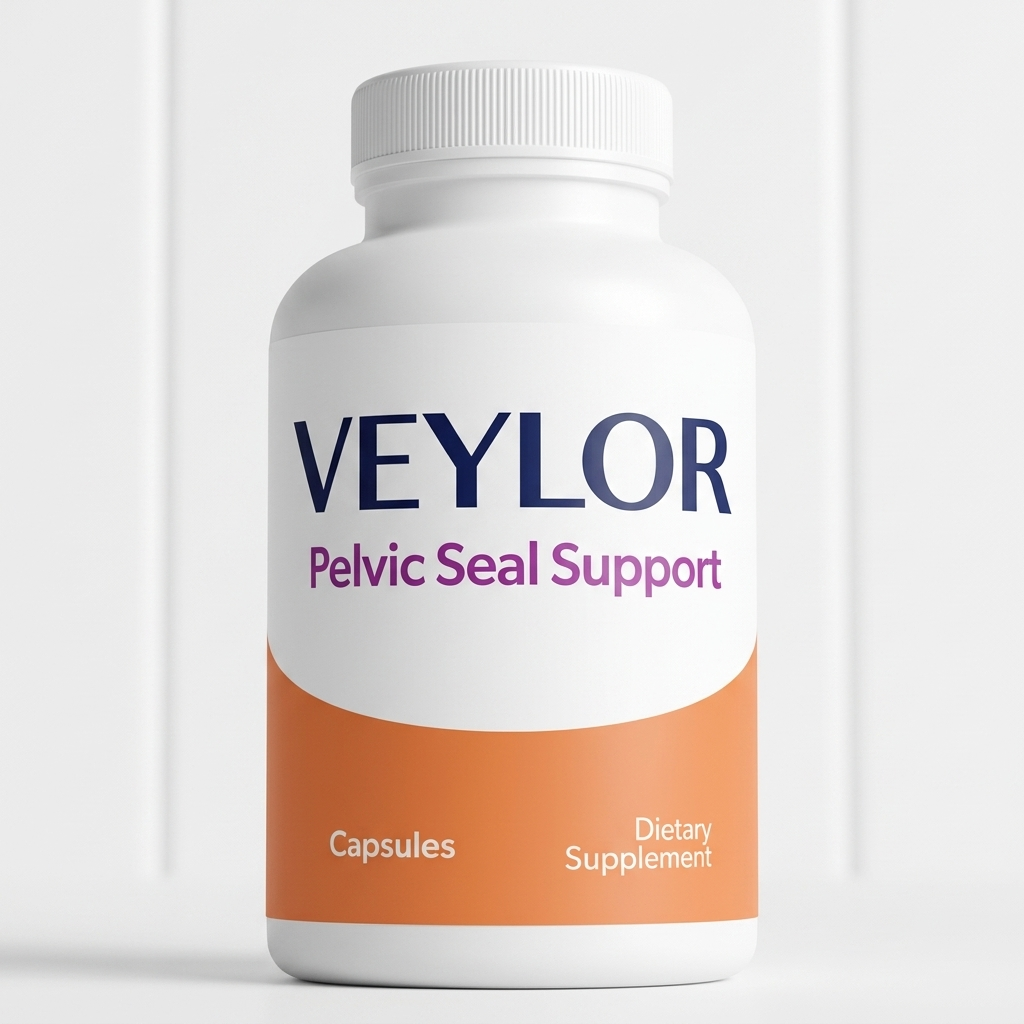
Feed the seal. Stop squeezing the wrong layer.
The approach the seventh appointment finally pointed me toward, in the studied form and amount. No Kegels. No devices. Give it a full season and let the seal answer.
See how Veylor feeds the seal →Backed by a 90-day promise. Give it a full season. If your days and nights have not changed, keep the bottle and get your money back.
What a season of feeding the seal costs
Here is the plain arithmetic, right next to the pads and the co-pays. Feeding the seal runs about a dollar a day. Another year of hiding the leak, and of appointments that end in a shrug, costs more than that, every year, and buys you nothing but one more year of hiding. One of these two costs actually ends. The other never does.
Feed the seal for about $0.94 a day
Choose your season below. Every option ships free and discreet, and every option is covered by the same 90-day keep-the-bottle promise. Regular $44.99 a bottle. As low as $25.50 a bottle today.
Free discreet shipping on every option. 90-day money-back promise: give it a full season, and if nothing changes, keep the bottle and get your money back.
Why most women start with the six-month supply: feeding a faded seal is measured in months, not days, because collagen renews slowly. A single bottle shows you how your body responds. A full season gives the ring the runway it needs, for less than another year of pads and co-pays would quietly cost you, and it carries the exact same keep-the-bottle promise.
What other women are saying

“For two years I was up three, sometimes four times before dawn, tired before the day even started. A few weeks on this and my nights got quieter. Most mornings now I wake up realizing I never got up at all.”

“I used to brace every time a joke landed, because a real laugh meant a little escape. I wore black slacks everywhere, just in case. Now I laugh at my grandkids without that flinch, and I've started reaching for color again.”

“Every jump and quick pivot used to end with that little leak, so I quit the game I loved. About six weeks in, the leaks when I move eased off enough that I'm playing pickleball three mornings a week.”

“I slept straight through last night. No getting up at three, no lying there waiting for sleep to come back. First time in longer than I can remember.”

“My granddaughter had me laughing so hard at dinner and I just laughed. No bracing, no reaching for a towel. That used to be the moment I dreaded.”

“The folded towel that lived on my car seat is in the wash for good. I quit mapping out every restroom before I leave the house.”
What I wish I could tell myself six years ago
You are not a hypochondriac. You were not imagining it, and you were not failing at your Kegels. You were doing the right thing to the wrong layer, because the one question that would have explained everything was never asked. If a provider ever waves you off with nothing but "do your Kegels," it is fair to keep looking for one who will actually explain what is happening, the way that seventh appointment finally did for me. This sits alongside good care, not instead of it, and severe or sudden urinary symptoms always deserve a real medical look.
But if you have been dismissed, and quietly decided to just live with it, please hear the part it took me six years to hear. There is a real reason. It has a name. And for the first time, it can be fed instead of blamed on you.
Ask the question. Then feed the seal.
No more squeezing the wrong layer. No more appointments that end in a shrug. Give the collagen ring what menopause took, in the studied form and amount, and give it a full season to answer.
Get Veylor Pelvic Seal Support →Free discreet shipping. 90-day keep-the-bottle promise. Individual results vary.
P.S. Remember how the deal is written. You try Veylor for a full 90 days, and if your days and nights have not changed you keep the bottle and get your money back, so the only thing you are really deciding today is whether the seal finally gets fed, or fades for another season while you keep being told to squeeze. Feed the seal while it is in stock →
The women who saw the biggest change were the ones who stayed with it. In the study, more than 9 in 10 chose to keep going, while only about half on placebo did. The seal does not rebuild in a week, it rebuilds over a season, which is why the women who say it gave them their life back are almost always the ones who took the full 3 or 6-month supply, not a single bottle.
Advertorial. This article is sponsored content produced for Veylor and reflects the brand's perspective on bladder-neck health. The conversation described is a personal account and is illustrative, not medical advice.
These statements have not been evaluated by the Food and Drug Administration. This product is not intended to diagnose, treat, cure, or prevent any disease. Individual results vary. Persistent or severe urinary symptoms can have medical causes, please talk with your doctor.