The Pads Were Never Going to Fix It
They Told You It Was Just Your Age. It Wasn't.
Every woman over 50 hears the same thing about the leaks: that it is just getting older, so buy the pads and quietly manage it. Here is what that explanation has really cost you, why no pad has ever fixed it, and the one approach that finally reaches the layer underneath.

For too many women, the fifties arrive with a quiet new companion, and a silence around it.
You know the routine by now. You find the bathrooms first, before you find your seat. You keep a folded pad in the bottom of your purse, just in case. You brace for the sneeze, the cough, the big laugh with your grandchildren, the one that used to be pure joy and now comes with a flicker of dread. And somewhere along the way, someone, maybe a doctor, maybe a friend, maybe just the voice in your own head, told you the thing every woman over 50 gets told: it's just your age.
So you believed it. Why wouldn't you? Everyone says it. And once you believe a thing is simply age, you stop looking for a cause and start managing a symptom. You buy the pads and the liners. You plan the day around the nearest restroom. You quietly build a whole second life around hiding it, and tell almost no one.
It is the small surrenders that add up. The trampoline you wave off at the grandkids' house. The second cup of coffee you skip before a long drive. The aisle seat you now request without thinking, the one nearest the door. The way you rehearse the distance to the ladies' room in a new restaurant before the appetizers even arrive. The dark trousers you keep buying, and the light linen ones you leave on the rack. None of it feels like a decision. It feels like weather. But every one of those small edits is you, shrinking your own life by an inch to fit around something no one ever properly explained to you.
So before we go one sentence further, the part that matters most: you are not broken, and you are not alone. A great many women over 50 live with some form of leaking. It is one of the most common experiences of this whole stretch of life, and it has nothing to do with how disciplined you are, how many Kegels you did, or how hard you tried. But common is not the same as normal, and "just your age" is not the same as the truth.
The "it's just your age" lie
Here is what that little phrase actually does. It closes the file. The moment leaking gets filed under aging, it stops being a problem with a cause and becomes a fact of life you are told to accept. Nobody goes looking for the mechanism. Nobody asks what changed. You are simply pointed toward the pads aisle and sent on your way.
But age is not a mechanism. Getting older does not, by itself, open a valve. Something specific changes in a woman's body around menopause, and that something has a name. We will get to it. First, look honestly at what all those years of "just manage it" have really cost you, because the bill is bigger than the money.
What the pads were never built to do
A pad has exactly one job. It hides the leak. It does not tighten anything, feed anything, or repair anything. It is a very absorbent way of accepting the problem and carrying it around all day. Fine for one afternoon. A quiet heartbreak over years.
Every pad you have ever bought was sold to hide the leak, never to fix it. And the whole time you were paying to conceal it, the real cause was left completely alone to get worse.
Now do the math no one asks you to do. A pack of liners here, a box of overnight pads there. Even at a few dollars a week, a woman who has been managing this for ten or fifteen years has easily spent hundreds of dollars, and for many it quietly passes a thousand, not to solve anything, but to conceal it. That is the concealment trap: paying, month after month, for the privilege of hiding a problem that keeps advancing behind the pad.
And the money is the smaller cost. The larger one is the bracing. The rehearsing. The mapping of every room by its exits. The slow narrowing of a life that used to be wide. Pads ask you to pay twice, once at the register and once in everything you stop doing, and they never once touch the reason you reached for them.
It was never age. It has a name.
So if it isn't age, and it isn't something a pad can reach, what is it? For most women over 50, the leaks trace back to one specific, physical change, and it begins the moment estrogen starts to fall.

Picture the bladder neck as a drawstring. When the collagen ring around it is full and springy, it holds.
Around the bladder neck, the narrow opening at the base of the bladder, sits a small ring of collagen. When that collagen is full and springy, it draws the opening closed and keeps it there through every sneeze, laugh, and cough, without you ever thinking about it. That ring, not the big pelvic-floor muscle everyone loves to talk about, is the everyday seal.
Estrogen is what keeps that collagen renewed. As estrogen drops through and after menopause, the ring slowly loses its spring. The seal fades. A growing number of clinicians and formulators now call this gradual change Pelvic Seal Fade, and it explains what women have felt all along: the leaks crept in around the change, got slowly worse, and no amount of squeezing or padding ever came close to the real problem.
You cannot pad a seal back to life, and you cannot squeeze one back either. That single fact is why so many women feel they have "tried everything" and still reach for the liner. They were hiding a symptom, or training the wrong muscle, while the actual change was happening one layer over, in the collagen.
Why nothing you tried ever reached it
Once you know the seal is the thing, every method you have ever been handed sorts itself into a single question: does it reach the collagen ring at the bladder neck, or does it work on some other layer entirely? Walk through them honestly, one at a time.
Kegels and pelvic-floor exercises. These train the pelvic-floor muscle, the sling underneath, and for some women that helps a little. But the fading seal is collagen, not muscle, and you cannot squeeze collagen into renewing itself. This is why so many women do their Kegels faithfully for months and still keep a liner in the purse. They were strengthening the floor while the ceiling kept sagging.
Pads and liners. We have already been honest about these. They absorb what has already escaped. They are the very definition of downstream, catching the leak after the seal has failed, and by design they never go anywhere near the cause. You can wear them for thirty years and still leak on year thirty-one.
Bladder-training apps. These teach you to reschedule, to hold it a little longer, to stretch the gaps between trips by the clock. It is effort, it is discipline, and it is entirely about managing your behavior around a seal that is still fading. The app never feeds the ring. It just asks you to white-knuckle the timing.
Prescription options. There are medications, and for some women, with a doctor's guidance, they have a place. But most of them work by calming the bladder muscle or dampening the nerve signals, and they can come with dry mouth, other side effects, an ongoing cost, and a prescription to keep filling. Even at their best, they are not feeding the collagen seal either. They are quieting the alarm, not tending the door.
Line them up side by side, and the pattern is impossible to miss.
Five ways to face the leaks. One feeds the seal.
Here is every common approach, measured against the five things that actually matter once you know the seal is the cause. Read down the columns. Four of them work on the floor, the surface, the schedule, or the nerves. Only one is built to feed the collagen ring itself, instead of working around it.
Five columns. Four of them work on the floor, the surface, the schedule, or the nerves, and every one of them leaves the faded seal exactly as faded as it found it. One column feeds the seal itself, asks nothing to be worn or inserted, supports you around the clock, is built on studied ingredients, and lets you try it with the bottle in your hand and your money back if it does nothing. That is not a marketing trick. It is simply what happens when a thing is finally aimed at the cause instead of the symptom.
See the only column that feeds the seal →
You don't hide the seal. You feed it.
If the seal is made of collagen, and collagen fades when estrogen falls, then the honest question is not "how do I hide this better." It is "how do I give that ring back what it lost." You do not train it, and you certainly do not fix it with a thicker pad. You feed it. Two plant compounds have drawn the most research attention for supporting the tone and the tissue of exactly this region, and they happen to be the two most women have either never heard of, or never took in the form that was actually studied.
What the researchers actually found
This is the part where most bladder supplements go quiet, because they have nothing to point to. Here is the study that matters, and the numbers are worth reading slowly.
In a randomized, double-blind, placebo-controlled trial, the strongest kind of study there is, university researchers gave 120 women, aged 35 to 70, the same pumpkin-seed-and-soy-germ blend, at one gram a day for twelve weeks. These were women living with the exact daily reality this page is about: the urgency, the frequency, the trips that break the night in two.
By the end of the twelve weeks, compared with where they started, the women reported about a third fewer trips in the night. There were significant reductions in how often they went, how urgently, and how much. And here is the number that says the most about real life: more than nine in ten of the women on the blend found it helpful and wanted to keep taking it, compared with only about half of the women given a placebo. No adverse events were reported. The findings were published in a peer-reviewed journal, the Journal of Functional Foods, in 2014.
More than nine in ten women taking the pumpkin-seed-and-soy-germ blend wanted to keep taking it. On placebo, only about half did. Randomized, double-blind, placebo-controlled trial · 120 women aged 35 to 70 · one gram a day for 12 weeks · Journal of Functional Foods, 2014
Read that ratio again. It is one thing for a number on a chart to move. It is another thing entirely for nine out of ten women to reach the end of twelve weeks and say, plainly, keep it coming. That is the quiet sound of something touching the cause rather than the cover-up.
The studied extract, not the drugstore oil
Here is the detail that quietly separates this from the bin of "bladder pills" at the pharmacy. The trial did not use plain pressed pumpkin seed oil, the soft yellow stuff in most drugstore softgels. It used a standardized, water-soluble pumpkin seed extract, the concentrated form the researchers could measure and repeat. Most shelf products use a fraction of the studied amount, or the wrong form entirely, which is one more reason so many women concluded that "nothing works." Usually it was not that nothing works. It was that no one ever gave the seal the studied form, in the studied amount.
Built to feed the seal, not hide the leak
This is the exact idea Veylor Pelvic Seal Support was built around. Not a better pad. Not another thing to squeeze or schedule. The studied blend, at the studied dose, in a simple daily ritual.
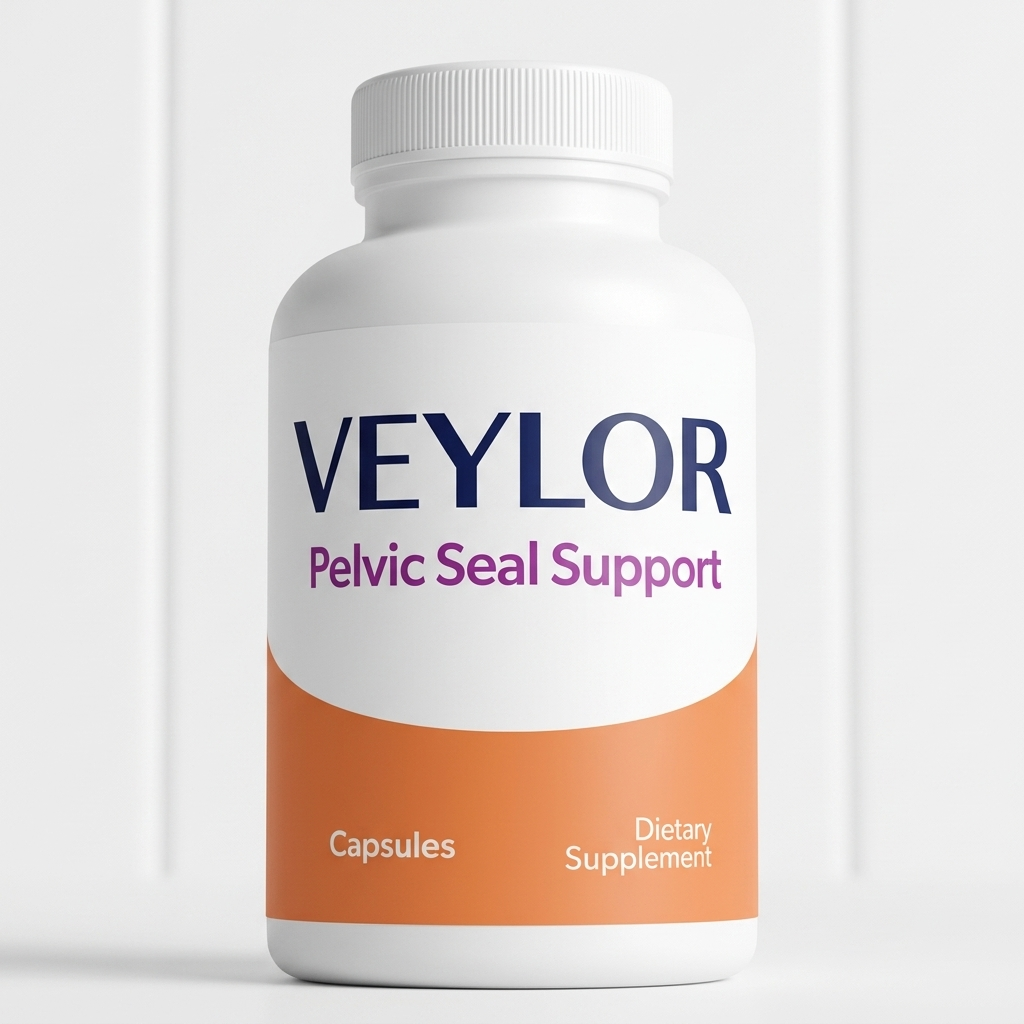
Feed the seal. Skip the pads aisle.
Veylor supplies the bladder-neck seal the studied form of pumpkin seed extract and soy germ, in the one-gram-a-day amount the research actually used, in a simple two-capsule morning-and-night ritual. No Kegels. No devices. No pad in the purse. Just the raw material the collagen ring lost when estrogen fell, given back to it every single day.
See how Veylor feeds the seal →Backed by a 90-day promise. Give it a full season. If your days and nights have not changed, keep the bottle and get your money back.
What feeding the seal actually feels like
Let us be honest about what this is, and what it is not. Veylor is not a drug, and it will not rebuild anything overnight. It is a daily way to help support normal bladder control by feeding the connective tissue at the bladder neck the material it has been missing, and the body takes its time with collagen. That is not a weakness. It is the whole point. You are not chasing a miracle. You are giving a slow, real change a slow, real answer, on the one layer that every pad and every Kegel quietly skipped.
A growing number of women over 50 are making the same quiet choice: to stop spending on the cover-up and start feeding the cause. And most of them are not chasing anything dramatic. They just want back the small, ordinary things this quietly took.
So picture it. Not a miracle, just an ordinary afternoon a few months from now. Your grandchild says something so absurd at the dinner table that it doubles you over, and the laugh comes all the way up, full and loud, and the only thing you feel is the laugh. No brace. No flicker of dread. No quiet reach for the purse on the floor. Later there is a slow walk by the lake with a friend who does not know any of this ever happened, and you are simply there for it, in the light linen you finally bought, present, thinking about the heron on the water instead of the distance to the restroom. That is the whole prize. Not a cure. Just your own life, handed quietly back to you, one un-braced laugh at a time.

Laughing without bracing for it. That is the part women say they miss most, and the part they most want back.
What a season of feeding the seal costs
Here is the plain arithmetic, right next to the pads. Feeding the seal runs about a dollar a day. Another year of hiding the leak runs more than that, every year, forever, and it buys you nothing but one more year of hiding. One of these two costs actually ends. The other never does.
Feed the seal for about $0.94 a day
Choose your season below. Every option ships free and discreet, and every option is covered by the same 90-day keep-the-bottle promise. Regular $44.99 a bottle. As low as $25.50 a bottle today.
Free discreet shipping on every option. 90-day money-back promise: give it a full season, and if nothing changes, keep the bottle and get your money back.
Why six, for most women? Not as an upsell, but because feeding a faded seal is measured in months, not days. Collagen renews slowly. A single bottle shows you how your body responds. A full season gives the ring the runway it needs to answer, for less than another year of pads would quietly cost you. That is why most women start with the six-month supply, and why it carries the exact same promise as every other option: if nothing changes, you keep the bottle and get your money back.
The promise that takes the risk off you
Let us make this decision as small as it should be. You have already spent years, and real money, on things that never even aimed at the cause. So the deal here is simple, and it is written in your favor.
Try Veylor for a full 90 days. Give the seal an honest season. If your days feel no steadier and your nights break just as often, write to us and get every dollar back. You do not even send the bottle back. Keep it. The risk that this does not work for you sits entirely with us, not with you. All you are really deciding today is whether the collagen ring finally gets fed, or spends another season fading while you keep paying to hide it.
Try it with the bottle in your hand →
Why we make so few bottles
One honest note about supply. Because every bottle is made to the full one-gram-a-day dose the researchers used, with the standardized extract and not the cheap pressed oil, we simply cannot stamp these out by the pallet the way the pad companies stamp out liners. We make a limited run, and when a run is spoken for, the next women wait for the next batch. There is no manufactured countdown here, and no fake "only three left." It is just the plain reality of making something to the studied dose instead of to the lowest possible cost. If the supply you want is in stock as you read this, that is the moment to take it.
Two women, one year from now
Picture two women, both 58 today, both tired of mapping every room by its exits.
The first decides it is probably just her age after all, and keeps doing what she has always done. She buys the next box of liners, and the one after that. She keeps the pad in the purse, keeps skipping the second coffee, keeps waving off the trampoline. A year from now she is exactly where she is today, only a little more resigned, a little more shrunken around it, and a few hundred dollars lighter. And underneath it all, unfed and untouched, the collagen seal she was never told about has quietly faded a little further, because nothing she did that whole year ever reached it.
The second woman decides to feed the seal. She gives it a season, the way you would give any slow, real thing a real chance. Maybe it changes everything for her, maybe it changes a great deal, and because the promise is what it is, the only thing she truly risks is the few minutes it takes to start. A year from now she is, at the very least, a woman who finally aimed at the cause instead of paying to hide it.
The leaks do not pause while you decide. The seal does not wait. Every season spent hiding is a season the ring spends fading. The only real question left is which of those two women you would rather be, a year from now.
Be the woman who fed the seal →
What other women are saying

“For two years I was up three, sometimes four times before dawn, tired before the day even started. A few weeks on this and my nights got quieter. Most mornings now I wake up realizing I never got up at all.”

“I used to brace every time a joke landed, because a real laugh meant a little escape. I wore black slacks everywhere, just in case. Now I laugh at my grandkids without that flinch, and I've started reaching for color again.”

“Every jump and quick pivot used to end with that little leak, so I quit the game I loved. About six weeks in, the leaks when I move eased off enough that I'm playing pickleball three mornings a week.”

“I slept straight through last night. No getting up at three, no lying there waiting for sleep to come back. First time in longer than I can remember.”

“My granddaughter had me laughing so hard at dinner and I just laughed. No bracing, no reaching for a towel. That used to be the moment I dreaded.”

“The folded towel that lived on my car seat is in the wash for good. I quit mapping out every restroom before I leave the house.”
One last thing, from one woman to another
If you take nothing else from all of these words, take this. It was never that you did not try hard enough. It was never simply your age. For most women over 50, the leaks trace back to a collagen seal at the bladder neck that quietly faded when estrogen did, a layer no pad was ever going to reach, no muscle you could squeeze, and no app could reschedule. Pads manage the symptom by the hour. Feeding the seal is how you stop managing and start addressing the cause.
You have quietly spent enough, in money and in dread, on hiding it. This is the first thing in years aimed at the actual reason, and the promise means the only way to know is to let the seal show you.
It was never age. Feed the seal.
No more mapping the bathrooms. No more pad in the purse just in case. Give the collagen ring what menopause took, in the studied form and the studied amount, and give it a full season to answer.
Get Veylor Pelvic Seal Support →Free discreet shipping. 90-day keep-the-bottle promise. Individual results vary.
P.S. Remember how the deal is written. You try Veylor for a full 90 days, and if your days and nights have not changed, you keep the bottle and get your money back, so the only thing you are really deciding today is whether the seal gets fed, or fades for another season. And because every bottle is made to the full studied dose rather than the lowest cost, each run is limited. If the supply you want is in stock right now, that is the moment. Feed the seal while it is in stock →
Advertorial. This article is sponsored content produced for Veylor and reflects the brand's perspective on bladder-neck health.
These statements have not been evaluated by the Food and Drug Administration. This product is not intended to diagnose, treat, cure, or prevent any disease. Individual results vary. Persistent or severe urinary symptoms can have medical causes, please talk with your doctor.